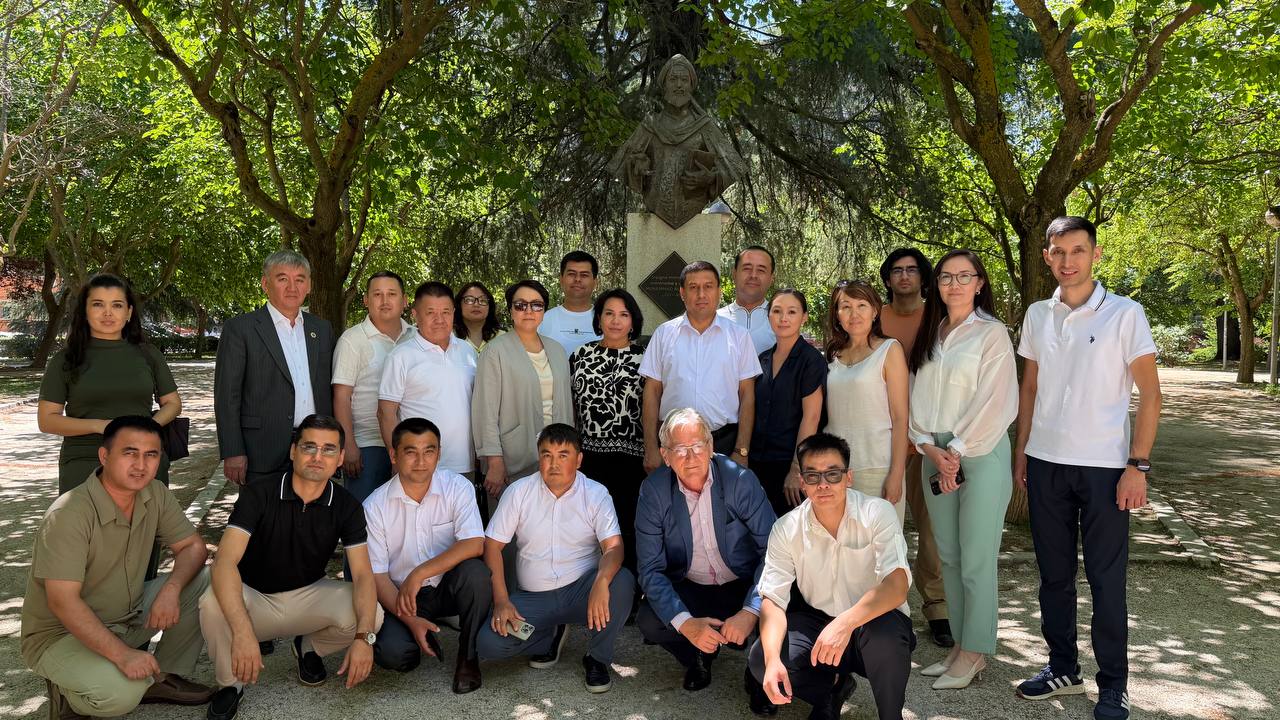
As part of the first day of the international training programme for teaching staff organised in Madrid within the framework of the Cyber4CA project, participants visited the Universidad Politécnica de Madrid and its Higher Technical School of Telecommunication Engineering.
During the visit, project participants became closely acquainted with the university’s academic environment, educational infrastructure, modern laboratories, and technical facilities supporting teaching and research activities in the field of cybersecurity. Representatives of the university provided information on the organisation of cybersecurity education, the integration of theoretical knowledge with practical laboratory sessions, and the use of virtual environments and modern technological tools.
The visit enabled participants to study advanced approaches to the training of cybersecurity specialists, observe the integration of education and scientific research, and consider how these practices could be adapted to the educational processes of partner universities. The project partners also exchanged views on the development of practice-oriented education, the establishment of CyberLab facilities, and the expansion of academic cooperation.
A particularly significant part of the visit was the tour of the monument dedicated to the memory of the great encyclopaedic scholar Muhammad al-Khwarizmi. Muhammad ibn Musa al-Khwarizmi is recognised in the history of world science as an outstanding scholar who made an invaluable contribution to the development of mathematics, astronomy, geography, and computational methods.
Al-Khwarizmi’s scientific works in the field of algebra laid an important foundation for the establishment of algebra as an independent branch of science. His works devoted to the systematic solution of equations had a profound influence on the subsequent development of scientific schools in both the East and the West. The term “algebra” itself is associated with the concept of “al-jabr” used in one of his most renowned works.
The concept of an “algorithm”, which is widely used today in information technology, programming, artificial intelligence, and cybersecurity, is also directly connected to the Latinised form of Al-Khwarizmi’s name. Algorithms form the basis of modern digital systems and play a vital role in data processing, software development, the design of security mechanisms, and the detection of cyberattacks.
From this perspective, the visit to the monument of Muhammad al-Khwarizmi further enriched the scientific and symbolic significance of the Cyber4CA training. The great scholar’s scientific legacy demonstrates the historical foundations of modern cybersecurity, computer science, and digital technologies. His scientific reasoning, precise computational methods, and systematic approach continue to retain their relevance in the development of contemporary innovative technologies.
This academic and cultural-educational visit once again highlighted the close relationship between historical scientific heritage and modern technological education. It provided participants not only with an opportunity to study the university’s infrastructure but also to gain a deeper understanding of the contribution made to world science by one of the greatest scholars to emerge from Central Asia.
Leave a Reply