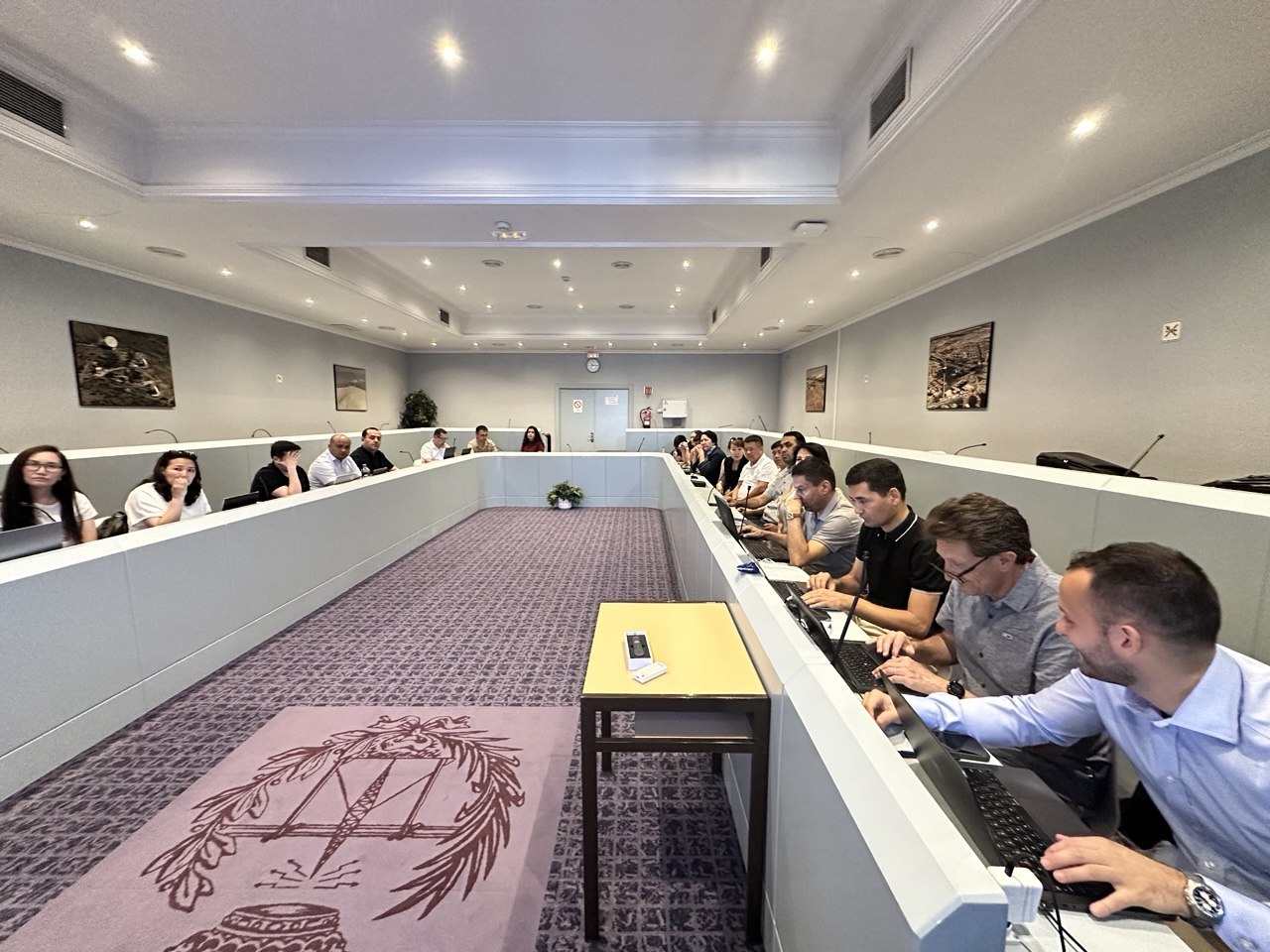
The third day of the international training programme for teaching staff, organised within the framework of the Cyber4CA project at the Universidad Politécnica de Madrid in Madrid, Spain, was dedicated to the development of practical cybersecurity laboratories, the advancement of interdisciplinary education, and the establishment of CyberLab infrastructure in higher education institutions.
The training sessions were delivered by experts from Scuola Superiore Sant’Anna, Italy. The programme began with a presentation on the development of cybersecurity education for modern intelligent systems, the role of interdisciplinary research in this process, and the experience of the Pisa innovation ecosystem.
During the practical part of the training, participants became acquainted with the stages of designing, launching, and integrating cybersecurity laboratory exercises into the educational process. The sessions were organised in a way that enabled participants to reproduce the demonstrated practices at their home institutions and adapt them to existing academic programmes.
The programme also covered the fundamental principles of cybersecurity and cryptography, the organisation of laboratory experiments, and the integration of theoretical knowledge with practical activities. The experiments were conducted live during the sessions, allowing participants to perform the exercises independently.
One of the key activities of the day was the development of an initial CyberLab model for master’s-level cybersecurity programmes. During the interactive session, participants discussed the objectives, technical infrastructure, priority areas, educational functions, and phased development of CyberLab facilities.
The CyberLab models developed by the groups were presented and reviewed, followed by discussions on implementation priorities, existing limitations, technical requirements, and potential risks. This activity enabled project partners to formulate preliminary concepts for the establishment of practical cybersecurity laboratories based on the capacities and needs of their respective universities.
The day concluded with a discussion and question-and-answer session focused on the development of practice-oriented cybersecurity education, the integration of laboratory activities into master’s programmes, and the implementation of the acquired experience at partner higher education institutions.
The training contributes to the development of modern, practice-oriented cybersecurity education based on international experience and supports the formation of the knowledge and skills required to establish CyberLab facilities at Central Asian universities.
Leave a Reply